
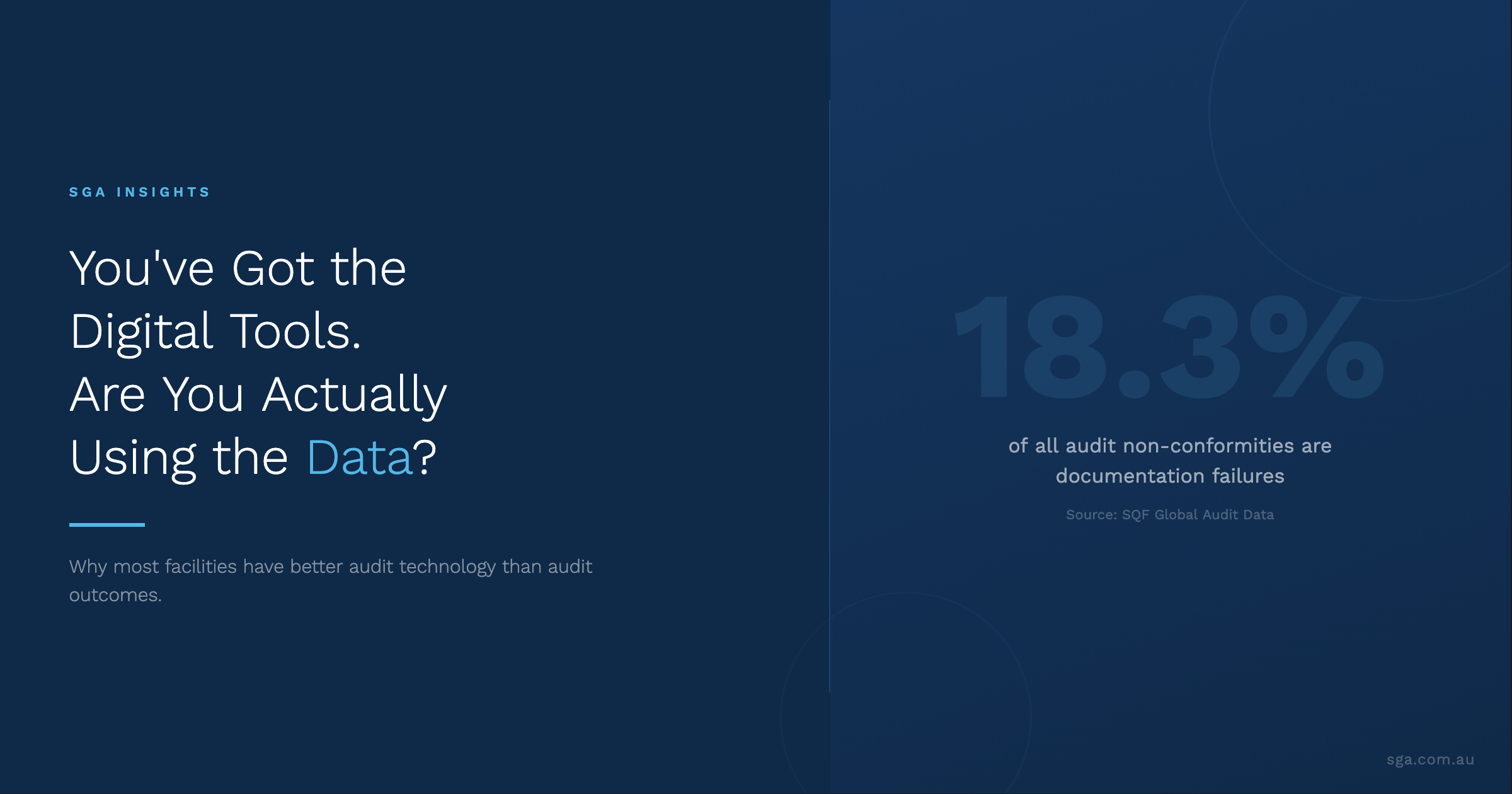
Why most food manufacturing facilities have better audit technology than audit outcomes.
Documenting cleaning procedures is the single most common non-conformity in food safety audits globally, accounting for 18.3% of all findings. Not equipment failures. Not contamination incidents. Documentation.
The irony is that most facilities already have the tools to fix this. Digital checklists, cloud-based compliance platforms, automated temperature logging. The technology is there. But having the tools and using them effectively are two very different things.
This is the gap that keeps showing up in audit after audit: facilities that have invested in digital systems but still operate with a reactive mindset. The checklist gets completed, the data gets stored, and nobody looks at it again until the auditor arrives.
The difference between collecting data and using it
There’s a pattern that plays out across food manufacturing facilities of every size.
A facility adopts a digital audit platform. The team fills in checklists on tablets instead of clipboards. Reports get stored in the cloud instead of a filing cabinet. On the surface, this looks like progress.
But the underlying behaviour hasn’t changed. Cleaning protocols are still copied and pasted between different equipment types. SOPs are still generic documents that get reviewed once a year. And the data flowing into the system is treated as a compliance record, not as operational intelligence.
The result is a facility that can prove it completed a cleaning cycle, but can’t tell you whether that cycle was actually effective.
What auditors are actually looking for in 2026
The regulatory landscape in Australia has tightened. The NSW Food Regulation 2025, now in effect, introduced stricter reporting timeframes for microbiological test results, higher penalties for non-compliance, and expanded licensing requirements. From February 2026, new national standards require berry, leafy vegetable, and melon businesses to strengthen food safety and traceability throughout the supply chain.
What this means in practice: auditors aren’t just checking whether you have a food safety program. They’re checking whether your program generates evidence that your controls are actually working under real operating conditions.
There’s a critical distinction here between validation and verification. Validation proves your cleaning process can achieve the required outcome. Verification proves it did achieve that outcome on a specific shift, on a specific date, for a specific piece of equipment. Most digital systems are set up to capture verification data. Far fewer facilities use that data to validate whether their entire cleaning program is fit for purpose.
Three signs your digital system isn’t working hard enough
1. Your SOPs look the same across different equipment
If the cleaning procedure for a CIP circuit reads the same as the procedure for an open conveyor belt, that’s a red flag. Different equipment carries different contamination risks. Biofilm in CIP circuits requires specific temperature and chemical concentration validation. Conveyor joints and floor/wall junctions require mechanical disruption before chemical treatment. Generic SOPs suggest the documentation was written for the auditor, not for the cleaning team.
2. You review data quarterly instead of daily
Digital platforms generate data every shift. If that data only gets reviewed during management meetings or pre-audit preparation, the facility is missing the entire point of real-time monitoring. A trend in ATP swab results over two weeks tells you something is changing before it becomes a non-conformance. A single failed swab on audit day tells you it’s already too late.
3. Your corrective actions are repetitive
When the same corrective action appears multiple times in your system (re-clean, re-train, re-test) it usually means the root cause was never addressed. Digital systems make it easy to log a corrective action and close the finding. They also make it easy to spot when the same finding keeps appearing, if anyone is looking.
What “using the data” actually looks like
The facilities that consistently perform well in audits share a common trait: they treat their digital audit data as a management tool, not a compliance archive.
In practice, this means:
Trend analysis, not just pass/fail. ATP swab results, CIP cycle temperatures, chemical concentrations. These aren’t just data points to record. They’re trend lines that reveal where contamination risk is building before it reaches a critical threshold. A facility that reviews this data daily can intervene proactively. A facility that reviews it quarterly is always reacting.
Facility-specific protocols. The data should inform how cleaning is planned, not just whether it was completed. If ATP results consistently flag specific zones or equipment, that’s a signal to adjust the cleaning protocol for those areas. This is where the shift from reactive to predictive starts.
Cleaning validation under real conditions. Validation studies conducted in controlled conditions are a starting point, but they don’t tell you how your cleaning program performs during a rushed Friday night changeover with a skeleton crew. Digital verification data from actual operating shifts does. That’s the evidence auditors are increasingly looking for.
The documentation gap that costs the most
Across BRCGS, IFS, and SQF audits, hygiene, cleaning, and sanitation consistently account for a high proportion of findings. The most common issues aren’t dramatic failures. They’re quiet gaps:
Areas not properly cleaned during scheduled sanitation. Master sanitation schedules that are inadequate or not followed. Titration kits that have expired. Staff not trained to identify signs of insufficient cleaning. Hard-to-reach niches excluded from cleaning protocols entirely.
These are the kinds of issues that digital systems are designed to catch. But only if the system is configured to flag them, and only if someone is reviewing the flags.
Where this is heading
The direction is clear. Regulatory bodies are moving toward more frequent, risk-based auditing. The NSW Food Regulation 2025 is one example. FSANZ’s 2024-25 annual report signals continued focus on food safety surveillance and standards development.
For food manufacturers, this means the cost of a reactive approach is going up. Facilities that treat digital tools as a checkbox exercise will find themselves spending more time and resources on audit preparation, corrective actions, and repeat findings.
Facilities that use the data their systems generate, daily, proactively, and facility-specifically, will find that audits confirm what they already know.
The bottom line
Most food manufacturing facilities don’t have a technology problem. They have a data utilisation problem. The digital tools are installed. The checklists are being completed. But the intelligence sitting inside those systems isn’t being used to drive cleaning decisions, identify emerging risks, or validate that protocols are actually working under real conditions.
The shift isn’t about spending more on technology. It’s about changing how the data gets used after the checklist is completed.
The facilities that make this shift don’t prepare for audits. They just operate at a standard where the audit changes nothing about their day.
SGA works with food manufacturing facilities across Australia to build hygiene programs where cleaning is planned, verified, and documented at every shift. For a facility-specific conversation about your audit readiness, get in touch.